
Employer Holiday Party Liability Explained: 2026 Guide for Canadian Businesses
With the holidays fast approaching, it is time for corporations, employers and individuals to ensure that they fully understand their responsibilities and liabilities as hosts. There are two types of hosts we will examine in this blog. Casual or Social hosts such as hosts of house parties, are subject to the least stringent responsibilities, while Business hosts (or employer/corporate hosts) hosting work functions have the highest duty to their employees and attendees at a social function due to the special relationship that is created between an employer and its employees.
Social Hosts

As a social host it is important to understand that you as an individual may be held liable for the actions of your guests, even after they have left your premises. In a Supreme Court of Canada case known as Childs v Desormeaux, 2006 SCC 18, the court ruled that the host is not liable to monitor their guests “unless the host’s conduct implicates him or her in the creation or exacerbation of the risk.” In this case, the defendant hosted a “BYOB” (bring your own booze) party, and as a result, the court ruled that as a host they were not responsible for how much their guests drank as they essentially managed their own alcohol and did not serve them.
However, if the host for example, had provided any alcohol to their guests, and the host knew the guest was intoxicated, and then the guest unfortunately made the decision to drink and drive after the party, causing a serious motor vehicle collision which injured third parties, the host of the party might be liable for damages to the third parties.
As such, if you, as a social host, are serving alcohol or cannabis related products at your premises, and one of your guests becomes intoxicated and makes the decision to drive, and you make zero attempts at intervention, you have a high chance of being held liable if the outcome caused injuries to your guest or a third party.
Business / Employer Hosts
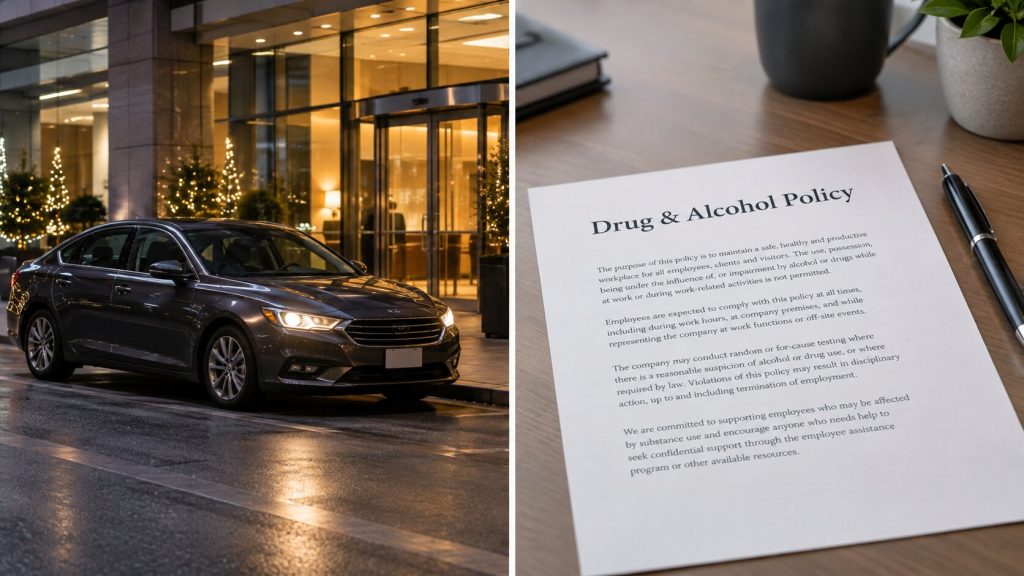
If you yourself are an employer and decide to throw a function for your employees and/or clients where alcohol or cannabis products are served, you may also be held liable for their actions as a result. As an employer, corporate responsibility towards employees, guests and others arise as soon as a business provides alcohol or cannabis products or encourages its consumption while the employee or client is under the company’s control. An employer has a duty to provide a safe workplace. This includes being safe at work related functions.
Your company’s policy manual should outline procedures for best practices in these situations such as:
- The provision of Ubers, taxis or designated drivers
- Monitoring intoxicant consumption
- Having a strict drug and alcohol policy for employees and contractors for work related functions
In terms of your liability as an employer, you can be directly liable or vicariously liable. With direct liability, the employer is liable to the injured party if the act occurred due to that employers’ own negligent acts or omissions. The employer can also be held liable through vicarious liability based on the acts or omissions of their employees who have injured another party.
By shifting the liability from the employer to a commercial host (hosting the function in a restaurant or bar), you may mitigate the majority of the liability, but not all of it.
The first case in Canada to apply host liability at the workplace was in Jacobsen v Nike Canada Ltd., [1996] B.C.J No. 363 (S.C.). The employer, Nike Canada was held liable for the injuries of one of its employees who they served alcohol to during a work function. This employee later went on to another commercial host and drank more alcohol, then drove their vehicle home where they sustained serious injuries as a result of a motor vehicle accident, which left the employee a quadriplegic. The employee sued Nike and the court found them liable, stating that it owed the employee a standard of care and served alcohol to him without monitoring the employee’s consumption or ensuring that the employee did not drive while impaired. The total damages for the employees’ injuries, (which Nike was 75% liable for) exceeded $2.5 million.
Thus, as an employer it is VERY important to ensure that you are monitoring your employees and clients and other guests during your functions if your plan is to host a work-related function, as well as during those fun Friday casual afternoon work drinks. If you are unaware of or negligent to your duty of care during what is intended to be a goodwill/ employee bonding situation, this may end up costing you millions of dollars but not least of all, it could cost someone their life.
If you have questions on how to limit your liability for the upcoming holiday season such as drafting employment policies related to work related functions, a properly crafted Drug and Alcohol Policy or a Respect in the Workplace policy, please contact Kim Nutz, Senior Legal Counsel at knutz@west-legal.ca.


About Post Author